



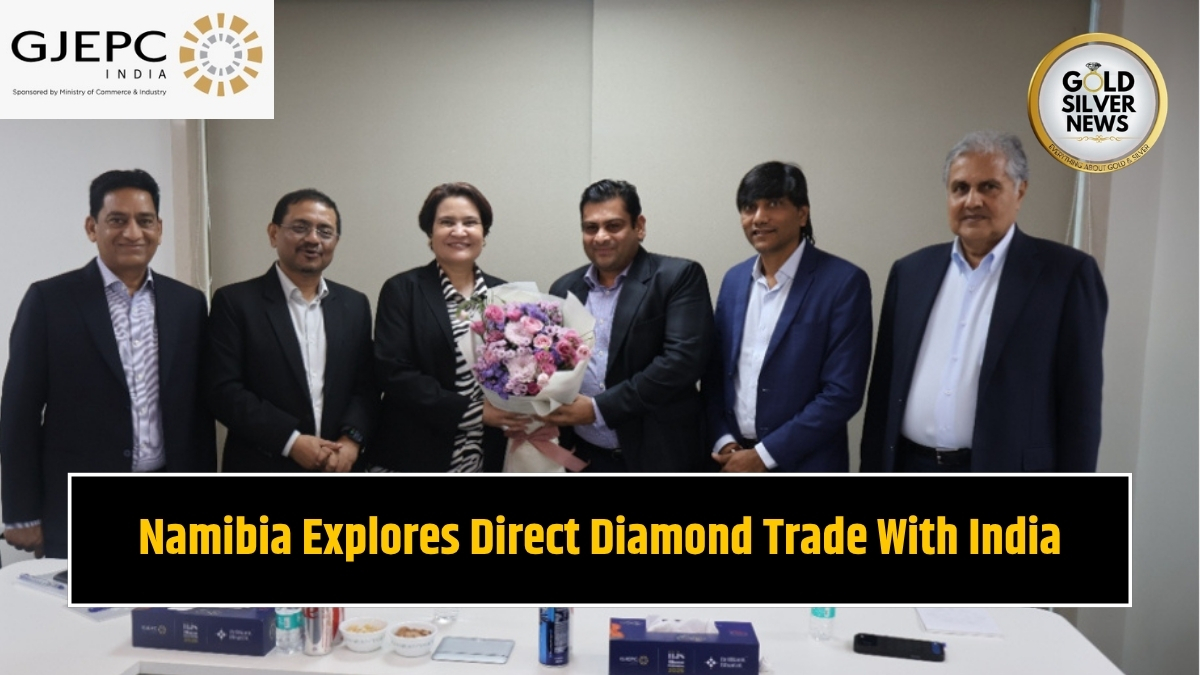
A senior Namibian delegation has explored opportunities to expand direct rough diamond trade with India following the proposed introduction of a 15-year income-tax exemption for rough diamond sales through Special Notified Zones (SNZs) at the Bharat Diamond Bourse (BDB) and Surat Diamond Bourse. The visit was facilitated by the Gem & Jewellery Export Promotion Council (GJEPC).
Check out the latest Gold, Silver prices in MCX, International Market, Sarafa and your city on our new website– https://goldpricetodaynews.com/
Namibia Delegation Visits GJEPC, BDB and Indian Diamond Trading Centre
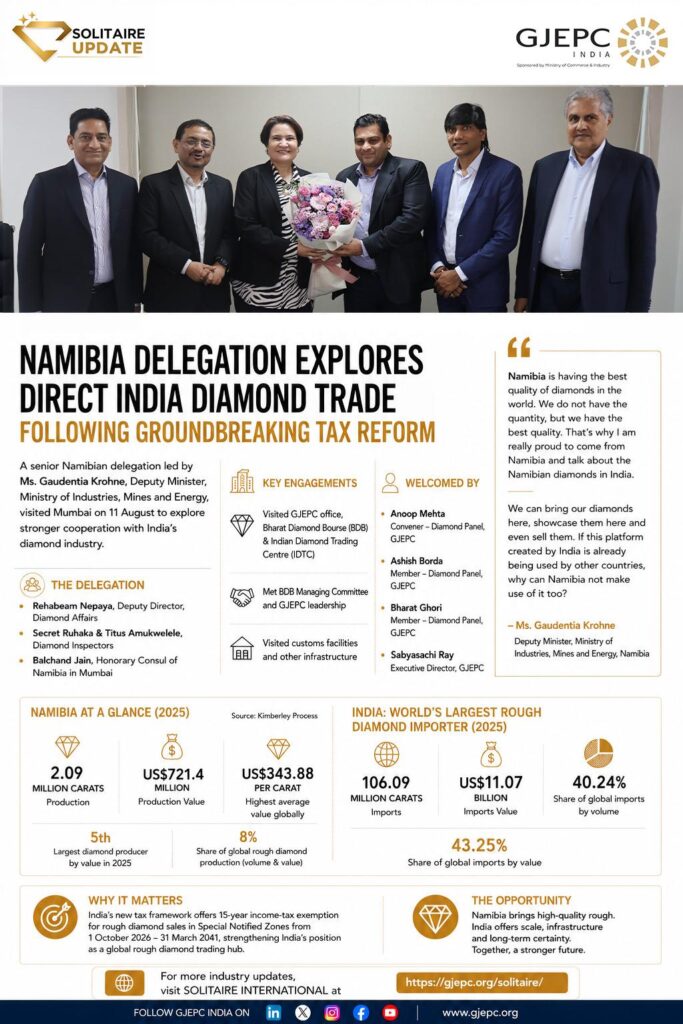
The senior delegation from Namibia, led by Ms. Gaudentia Krohne, Deputy Minister, Ministry of Industries, Mines and Energy, visited the GJEPC office on August 11 for a B2B engagement focused on strengthening cooperation between the Namibian and Indian diamond industries.
The delegation included Rehabeam Nepaya, Deputy Director, Diamond Affairs; Secret Ruhaka and Titus Amukwelele, Diamond Inspectors; and Balchand Jain, Honorary Consul of Namibia in Mumbai.
During the visit, the officials toured the GJEPC office, Bharat Diamond Bourse (BDB) and Indian Diamond Trading Centre (IDTC). They also visited customs facilities and other related infrastructure to understand India’s diamond trading and manufacturing ecosystem.
The delegation was welcomed by Anoop Mehta, Convener – Diamond Panel, GJEPC; Ashish Borda and Bharat Ghori, both Members – Diamond Panel, GJEPC; and Sabyasachi Ray, Executive Director, GJEPC.
GJEPC Sees Opportunity to Make India a Global Rough Diamond Trading Hub
The proposed tax reform has created fresh possibilities for India to attract rough diamond producers and international trading companies.
Shri Kirit Bhansali, Chairman, GJEPC, said:
“Namibia produces the world’s highest-value rough diamonds, while India cuts and polishes 14 out of every 15 diamonds globally. With the proposed 15-year tax exemption for Special Notified Zones, India can now offer producer nations not just manufacturing, but a global trading hub. We look forward to building a lasting partnership with Namibia.”
The proposal could allow India to leverage its established cutting and polishing industry while developing a larger role in the international rough diamond trade.
GJEPC Invites Namibia to Bring Rough Diamonds to India
GJEPC also highlighted the possibility of Namibian rough diamonds being traded directly through India’s notified Special Notified Zones.
Anoop Mehta, Convener – Diamond Panel, GJEPC, said:
“We have invited Namibia to bring its rough diamonds to India and utilise the new tax framework for trading through the Special Notified Zones. This will give Indian MSMEs more direct access to high-quality rough diamonds without the need to travel overseas. We are exploring this opportunity closely and, if the discussions progress, we would be happy to work towards an MoU with Namibia. We are very positive that, with this new policy, a greater share of Namibia’s diamond trade can come directly to India.”
The proposal could give Indian small and medium-sized diamond businesses greater access to Namibian rough stones without requiring them to travel to overseas trading centres.
Proposed 15-Year Tax Exemption Could Boost Rough Diamond Trading
The Namibian delegation’s visit comes shortly after the introduction of the Taxation and Other Laws (Amendment) Bill, 2026, which proposed a 15-year income-tax exemption on income generated from the sale of rough diamonds through notified Special Notified Zones.
The proposed framework covers the SNZs at Bharat Diamond Bourse in Mumbai and Surat Diamond Bourse.
The measure was proposed as part of efforts to strengthen India’s position as an international centre for rough diamond trading.
Under the proposal, the tax exemption would cover foreign mining companies, sightholders, brokers, aggregators, and tender and auction entities involved in rough diamond sales.
The proposed exemption would apply from October 1, 2026, through the tax year ending March 31, 2041.
Namibia Produces High-Value Rough Diamonds
Namibia holds a strategically important position in the global diamond industry because of the exceptionally high value of its rough diamond production.
According to Kimberley Process data, Namibia produced 2.09 million carats of diamonds valued at 721.4 million US dollars in 2025.
Its average production value reached 343.88 US dollars per carat, the highest among all diamond-producing countries during the year.
Namibia ranked as the fifth-largest diamond producer by value in 2025 and represented approximately 8% of global rough diamond production by both volume and value.
The country exported 2.04 million carats valued at 578.4 million US dollars during 2025, according to Kimberley Process data.
Namibia Highlights Quality of Its Diamonds
Speaking about the country’s diamond production, Ms. Gaudentia Krohne, Deputy Minister, Ministry of Industries, Mines and Energy, said:
“Namibia is having the best quality of diamonds in the world. We do not have the quantity, but we have the best quality. That’s why I am really proud to come from Namibia and talk about the Namibian diamonds in India.”
Krohne also pointed to the possibility of using India’s diamond trading infrastructure to bring Namibian rough diamonds closer to Indian buyers.
“We can bring our diamonds here, showcase them here and even sell them. If this platform created by India is already being used by other countries, why can Namibia not make use of it too?”
India Remains World’s Largest Rough Diamond Importing Market
India’s large-scale diamond manufacturing and trading ecosystem makes it an important potential destination for Namibian rough diamonds.
India was the world’s largest rough diamond importing market in 2025, bringing in 106.09 million carats valued at 11.07 billion US dollars, according to the information provided by GJEPC.
The combination of India’s substantial processing capacity, established trading infrastructure and the proposed long-term tax framework could create a stronger channel for direct trade between Indian buyers and international diamond producers.
BDB and IDTC Showcase India’s Diamond Infrastructure
The Namibian delegation’s programme was designed to provide an overview of India’s complete diamond ecosystem, from rough diamond trading to manufacturing.
At the Bharat Diamond Bourse, the delegation received an overview of the Indian diamond industry, met members of the BDB Managing Committee and visited the Indian Diamond Trading Centre (IDTC).
The planned engagement at SEEPZ was intended to provide the Namibian officials with a closer understanding of India’s diamond manufacturing infrastructure, operations and capabilities.
The IDTC platform was developed to help smaller Indian manufacturers gain access to international rough diamonds without incurring the costs associated with travelling to overseas trading markets.
For Namibia, India’s value proposition combines a large diamond manufacturing base and established market infrastructure with the proposed long-term tax framework for rough diamond trading through Special Notified Zones.
India-Namibia Diamond Trade Could Gain Momentum
The visit signals growing interest in creating a more direct link between Namibia’s rough diamond production and India’s extensive cutting and polishing industry.
For Namibia, India provides substantial processing capacity and an established diamond market. For India, greater participation from major producing nations could help strengthen its ambition to become a more important global hub for rough diamond trading.
If discussions progress, the proposed tax framework and the country’s existing diamond infrastructure could support deeper commercial ties between India and Namibia.
About GJEPC
The Gem & Jewellery Export Promotion Council (GJEPC) was established by the Ministry of Commerce, Government of India, in 1966 as one of the Export Promotion Councils created to support India’s export growth as the country’s post-Independence economy expanded into international markets.
Since 1998, GJEPC has operated with autonomous status. It is the apex organisation representing India’s gems and jewellery industry and currently has more than 11,000 members.
GJEPC is headquartered in Mumbai and has regional offices in New Delhi, Kolkata, Chennai, Surat and Jaipur, covering India’s major gems and jewellery centres. Through these offices, the council works closely with industry members and provides services and support across the sector.
Over the decades, GJEPC has expanded its promotional activities and services while strengthening its reach across India’s gems and jewellery industry.
FAQs
1. Why did the Namibian delegation visit India?
The senior Namibian delegation visited India to explore greater cooperation and direct rough diamond trade between Namibia and India’s diamond industry. The officials visited GJEPC, Bharat Diamond Bourse, the Indian Diamond Trading Centre and other infrastructure facilities to understand India’s trading, customs and manufacturing ecosystem.
2. What tax benefit has been proposed for rough diamond trading in India?
The Taxation and Other Laws (Amendment) Bill, 2026 proposed a 15-year income-tax exemption on income from the sale of rough diamonds through notified Special Notified Zones at Bharat Diamond Bourse and Surat Diamond Bourse. The proposed exemption would apply from October 1, 2026, through March 31, 2041.
3. How important is Namibia in the global diamond market?
Namibia is an important producer of high-value rough diamonds. Kimberley Process data cited in the material shows that the country produced 2.09 million carats valued at 721.4 million US dollars in 2025. Its average production value of 343.88 US dollars per carat was the highest among producing countries that year.
4. Why is India an attractive market for Namibian rough diamonds?
India has a large-scale diamond cutting, polishing and trading ecosystem and was the world’s largest rough diamond importing market in 2025, with imports of 106.09 million carats valued at 11.07 billion US dollars. India’s proposed tax framework and established trading infrastructure could provide Namibia with a more direct route to Indian buyers.
5. Could India and Namibia sign an MoU on diamond trade?
GJEPC said it would be open to working towards an MoU with Namibia if discussions progress. The proposed partnership could potentially increase the share of Namibian rough diamond trade conducted directly through India’s Special Notified Zones while giving Indian MSMEs improved access to high-quality Namibian rough diamonds.
Gold Price Today Digital Media Network
Facebook Page (129K Followers)- https://www.facebook.com/Goldsilverpricetoday
Facebook group of (80K Jewellers Member – Sunar Jewellers Ekta – https://www.facebook.com/groups/goldsilverpricenews
Website (100000 Users)- https://ohq.plp.mybluehostin.me/
Instagram (51K Followers)- https://www.instagram.com/goldpricetodaynews/
X- https://twitter.com/today_gold
Telegram Group (2000 Members)- https://telegram.me/goldsilverprice
Magazine (20000 Digital Subscribers): Gold Silver News For Magazine Subscription Contact +919111435279
Whatsapp News(25000 Members): +91844846958