



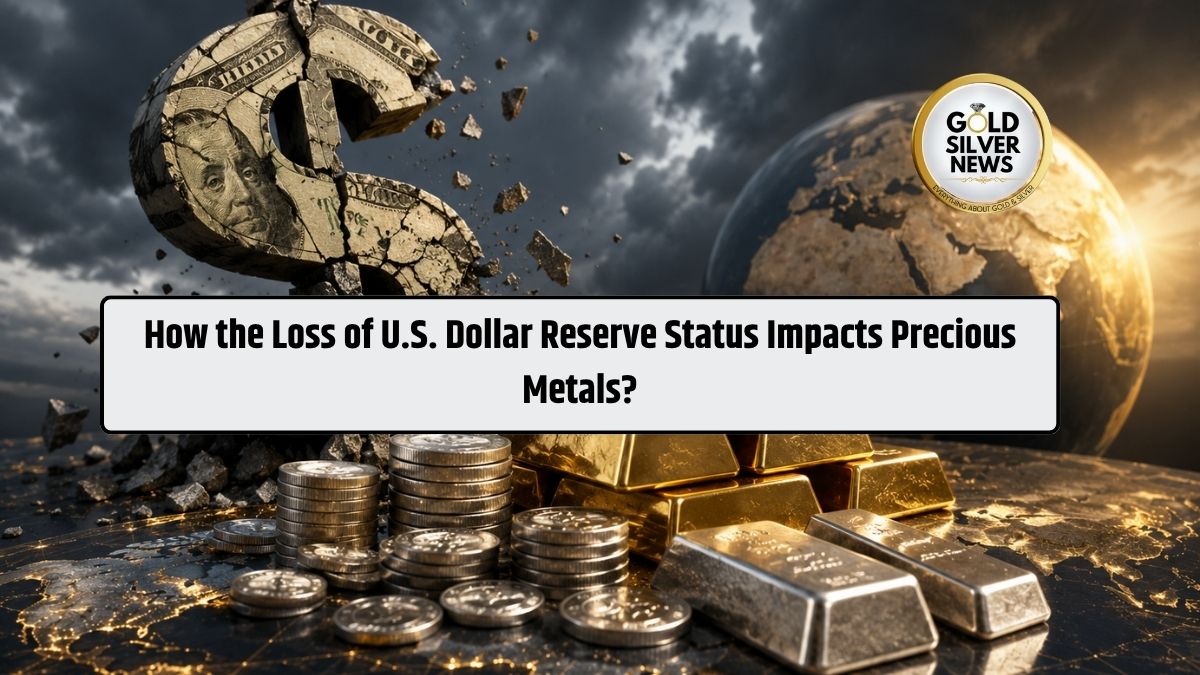
US Dollar Reserve Status: For over eight decades, the U.S. dollar has reigned as the undisputed anchor of global trade, but a recurring historical pattern suggests that this era of dominance may be approaching a dramatic conclusion. As the greenback’s share of global foreign exchange reserves continues its steady decline, investors are increasingly asking: What happens to gold and silver when the dollar loses its reserve status? History indicates that such transitions are rarely subtle; they represent massive shifts in global economic power, often resulting in a profound migration of capital toward “hard money” assets that carry no counterparty risk.
A System Under Strain: The Erosion of Fiat Trust
The current global monetary architecture, established in 1944 and severed from gold in 1971, is well past the typical 30-to-40-year lifespan of modern currency systems. Today, the “dollar standard” faces structural fragility that is increasingly visible to institutional players:
- Declining Reserves: The dollar’s share of global reserves has drifted from a 72% peak in 2001 to approximately 57% today.
- The Fiat Domino Effect: Because major currencies like the Euro and Yen are backed by the same government promises as the dollar, a crisis in the world’s primary reserve currency often triggers a global crisis of confidence in all paper money.
- Central Bank Accumulation: Realizing the shift, central banks have purchased over 1,000 tonnes of gold annually for three consecutive years (2022–2024), double the pace of the previous decade.
Why Precious Metals Become the New Anchor
When a reserve currency fails, capital does not simply vanish—it seeks a safe haven that cannot be printed or devalued by any single government. Gold and silver have outlasted every monetary transition in human history.
Gold: The Ultimate Monetary Anchor
In a transition away from the dollar, gold serves a dual purpose. It benefits directly from a weakening dollar (since gold is priced in USD), but more importantly, it offers the only liquid, universally recognized asset capable of anchoring a new monetary system. A 2025 survey revealed that 95% of central banks expect global gold reserves to continue increasing over the next 12 months.
Silver: The Crisis Amplifier
Silver often acts as a high-beta version of gold during monetary stress. During the stagflation of the 1970s—the last major era of dollar instability—silver surged from under 2 dollar to nearly 50 dollar per ounce. Its dual role as both a monetary asset and a critical industrial metal provides a unique demand profile that can accelerate gains during a flight to safety.
Historical Lessons: From Sterling to the Dollar
The transition away from a dominant currency is rarely overnight. When the British pound lost its status after 1945, the process took nearly thirty years, punctuated by devaluations and a 1976 IMF bailout. However, the current shift is structurally different: unlike previous transitions that moved between gold-linked currencies, we are now moving away from a system backed by nothing but government promises.
The Investor’s Window of Opportunity
History shows that the greatest benefits go to those who position themselves before a crisis becomes front-page news. As the 2026 economic landscape shifts, the accumulation of physical bullion represents more than just a hedge—it is an insurance policy against the structural reorganization of the global financial order.
FAQ’s
1. Why is the U.S. dollar’s reserve currency status being questioned?
The U.S. dollar’s share of global foreign exchange reserves has declined from nearly 72% in 2001 to around 57% today. Rising debt levels, inflation concerns, and growing geopolitical tensions have increased doubts about the long-term stability of the current dollar-based monetary system.
2. Why are central banks buying large amounts of gold?
Central banks are increasing gold reserves because gold is considered a safe-haven asset that carries no counterparty risk. Unlike paper currencies, gold cannot be printed or controlled by any single government, making it attractive during periods of economic uncertainty and currency instability.
3. How could gold benefit if the dollar weakens further?
Gold typically gains when the U.S. dollar weakens because it is priced in dollars globally. In times of monetary uncertainty, investors often move capital into gold as a store of value, which can increase demand and push prices higher.
4. Why is silver considered important during monetary crises?
Silver acts as both a precious metal and an industrial commodity, giving it a unique demand profile. Historically, silver has shown stronger percentage gains during periods of inflation and economic instability, especially when investors seek alternatives to traditional currencies.
5. What historical examples show reserve currency transitions?
One major example is the decline of the British pound after World War II, when the U.S. dollar gradually replaced it as the world’s dominant reserve currency. Experts note that such transitions usually take years and are often accompanied by economic uncertainty, inflation, and shifts toward hard assets like gold.
Gold Price Today Digital Media Network
Facebook Page (129K Followers)- https://www.facebook.com/Goldsilverpricetoday
Facebook group of (80K Jewellers Member – Sunar Jewellers Ekta – https://www.facebook.com/groups/goldsilverpricenews
Website (100000 Users)- https://ohq.plp.mybluehostin.me/
Instagram (51K Followers)- https://www.instagram.com/goldpricetodaynews/
X- https://twitter.com/today_gold
Telegram Group (2000 Members)- https://telegram.me/goldsilverprice
Magazine (20000 Digital Subscribers): Gold Silver News For Magazine Subscription Contact +919111435279
Whatsapp News(25000 Members): +918448469588