

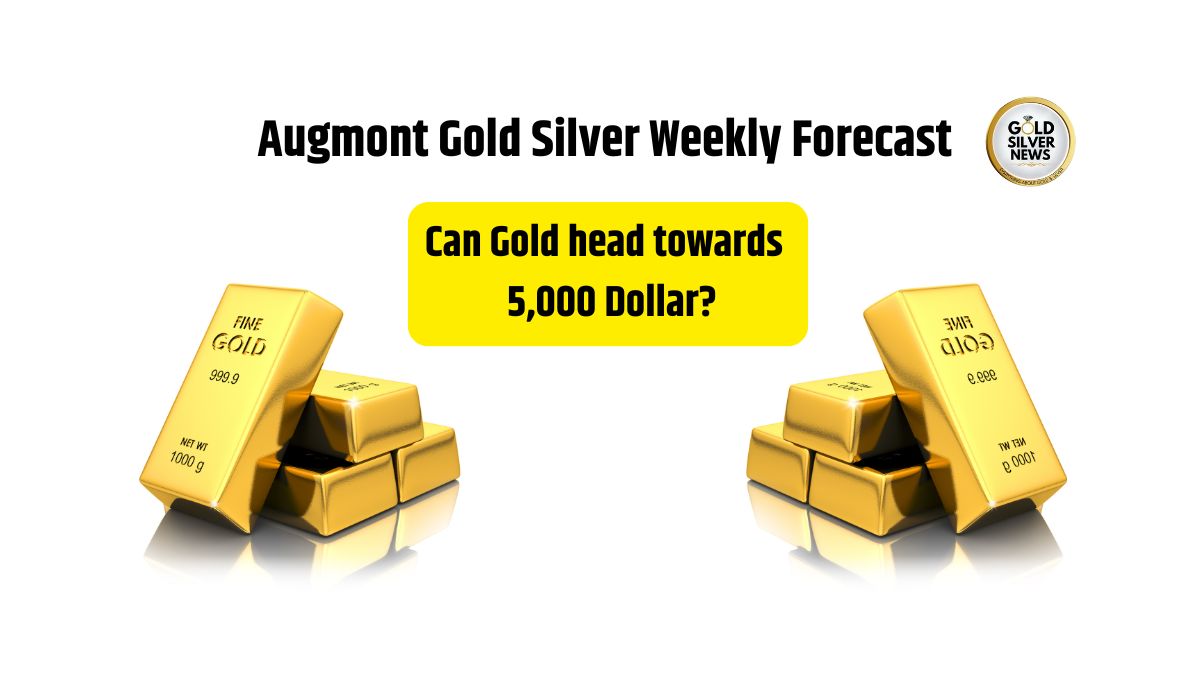
Augmont Gold Silver Weekly Forecast: The global bullion market is currently navigating a complex “tug-of-war” as intensifying US–Iran tensions provide geopolitical support, while a strengthened US dollar and “higher-for-longer” interest rate signals from the Federal Reserve continue to cap gains. Meanwhile a latest Augmont Weekly Report says Gold prices recovered modestly to trade above the 4,700 Dollar mark this week, a sustained breakout above this level could push prices toward 5,000 dollar
However, the market remains on edge ahead of the Federal Reserve’s critical April 29 meeting, which is expected to dictate the directional bias for precious metals through the remainder of 2026.
US–Iran Conflict Drives Market Sentiment
The primary market driver last week was the escalating US–Iran conflict centered on the Strait of Hormuz. Iran restricted commercial shipping and reportedly attacked foreign vessels, while the US responded by blockading Iranian ports—an action Tehran described as a ceasefire violation.
Further intensifying tensions, former US President Donald Trump directed naval action against vessels deploying mines in the strait. Additionally, US forces intercepted an Iranian oil supertanker in the Indian Ocean.
Despite such geopolitical risks typically boosting gold demand, the bullion market remained under pressure due to macroeconomic factors. Central banks continue to maintain tight monetary policies amid energy-driven inflation, keeping interest rates elevated and reducing gold’s attractiveness compared to yield-bearing assets.
Gold Recovers on Diplomatic Signals
The latest Augmont Weekly Report reveals that by the end of the week, gold prices recovered slightly, trading above 4,700 dollar. This rebound was driven by cautious optimism following diplomatic developments, including Iranian Foreign Minister Abbas Araghchi’s planned visit to Islamabad. Pakistani officials indicated the possibility of a meaningful peace breakthrough.
All Eyes on April 29
The US Federal Reserve is now expected to keep interest rates steady through 2026, moving away from earlier projections of rate cuts. There remains a possibility of further rate hikes as policymakers assess inflation risks arising from geopolitical tensions.
The upcoming Fed meeting on April 29 is now the most closely watched event, expected to significantly influence gold’s short-term price direction.
Rupee Weakens Amid Rising Crude Oil Prices
In India, the rupee weakened to around Rs 94 per US dollar, marking a three-week low. The depreciation is largely attributed to rising crude oil import costs. Despite intervention by the Reserve Bank of India (RBI), which sold dollars to stabilize the currency, strong demand from oil importers continued to exert pressure, resulting in a nearly 1% weekly decline.
Central Banks Continue Gold Accumulation
Global central banks remain consistent buyers of gold, although at a slower pace. Countries including China, India, Poland, and Turkey continued adding to their reserves. Gold purchases in January 2026 stood at 5 tonnes, compared to a monthly average of 27 tonnes in 2025.
Demand has also expanded geographically, with Malaysia and South Korea re-entering the market. Uzbekistan emerged as the largest buyer, while Russia recorded the highest sales at 9 tonnes. China continued to steadily increase its gold reserves.
Strong ETF Demand Signals Institutional Confidence
Institutional demand for gold remains robust. In 2025, gold exchange-traded funds (ETFs) saw record inflows of 89 billion dollar. The SPDR Gold Trust currently holds 1,073 metric tons, highlighting a significant shift in investment portfolios toward precious metals.
In February 2026, gold ETFs attracted 5.3 billion dollar in fresh inflows, primarily driven by North America and Asia. However, European funds recorded net outflows of $1.8 billion, reflecting mixed regional sentiment.
Silver Prices Supported by Supply Tightness and Demand
Silver prices are receiving support from tightening global supply. China’s silver imports reached 206.76 tonnes during January–February 2026, the highest in eight years.
In India, industrial buyers have been actively purchasing during price dips, providing a strong support base. Additionally, increased demand during the wedding season has further boosted consumption, with jewellery purchases rising across major cities.
Cautious Sentiment Prevails
Overall sentiment in the bullion market remains cautious. A strong US dollar and rising Treasury yields are increasing the opportunity cost of holding gold, limiting upside potential.
Key upcoming events include:
- US Federal Reserve policy decision (April 29)
- US Q1 GDP data release (April 30)
- Developments in US–Iran diplomatic relations
These factors are expected to play a crucial role in shaping price trends in the near term
Technical Outlook
According to Augmont’s technical analysis, gold and silver are entering a phase of consolidation:
Gold Forecast: Gold faces immediate resistance at 4,850 dollar (~Rs 1,55,000). A sustained breakout above this level could push prices toward 5,000 dollar (~Rs 1,60,000). On the downside, support is placed at 4,650 dollar (~Rs 1,51,000). A breakdown below this level may trigger further weakness.
Silver Forecast: Silver is currently consolidating in a broad range between 73 dollar (~Rs 2,35,000) and 82 dollar (~Rs 2,58,000), reflecting a neutral-to-cautious trend. A breakout above the upper resistance zone could trigger fresh upside momentum, while a breakdown below support may lead to renewed selling pressure. Overall, silver is awaiting a directional breakout for the next major move.
FAQ’s
1. Why are gold prices rising despite economic pressures?
Gold is being supported mainly by geopolitical tensions, particularly the escalating US–Iran conflict. Such uncertainty typically drives investors toward safe-haven assets like gold. However, this rise is modest because broader macroeconomic factors are still weighing on prices.
2. What factors are preventing gold from rising sharply?
The main limiting factors are the strong US dollar and expectations that interest rates will remain higher for longer. When interest rates are high, investors prefer yield-bearing assets like bonds, reducing the attractiveness of non-yielding assets such as gold.
3. Why is the Federal Reserve’s April 29 meeting so crucial?
The Fed’s policy decision will shape expectations for interest rates through 2026. Any signals about keeping rates high or raising them further could pressure gold, while a softer stance could support prices. This makes the meeting a key trigger for short-term market direction.
4. What is the near-term price outlook for gold?
Technically, gold is trading in a consolidation phase. If prices break above 4,850 dollar, they could move toward the 5,000 dollar level. On the downside, if gold falls below 4,650 dollar, it may see further weakness in the short term.
5. What is driving demand for silver in the current market?
Silver is benefiting from tight global supply and strong industrial demand, particularly from countries like China. In India, buying during price dips and increased jewellery demand during the wedding season are also supporting prices, keeping silver in a stable range.
Gold Price Today Digital Media Network
Facebook Page (129K Followers)- https://www.facebook.com/Goldsilverpricetoday
Facebook group of (80K Jewellers Member – Sunar Jewellers Ekta – https://www.facebook.com/groups/goldsilverpricenews
Website (100000 Users)- https://ohq.plp.mybluehostin.me/
Instagram (51K Followers)- https://www.instagram.com/goldpricetodaynews/
X- https://twitter.com/today_gold
Telegram Group (2000 Members)- https://telegram.me/goldsilverprice
Magazine (20000 Digital Subscribers): Gold Silver News For Magazine Subscription Contact +919111435279
Whatsapp News(25000 Members): +918448469588