



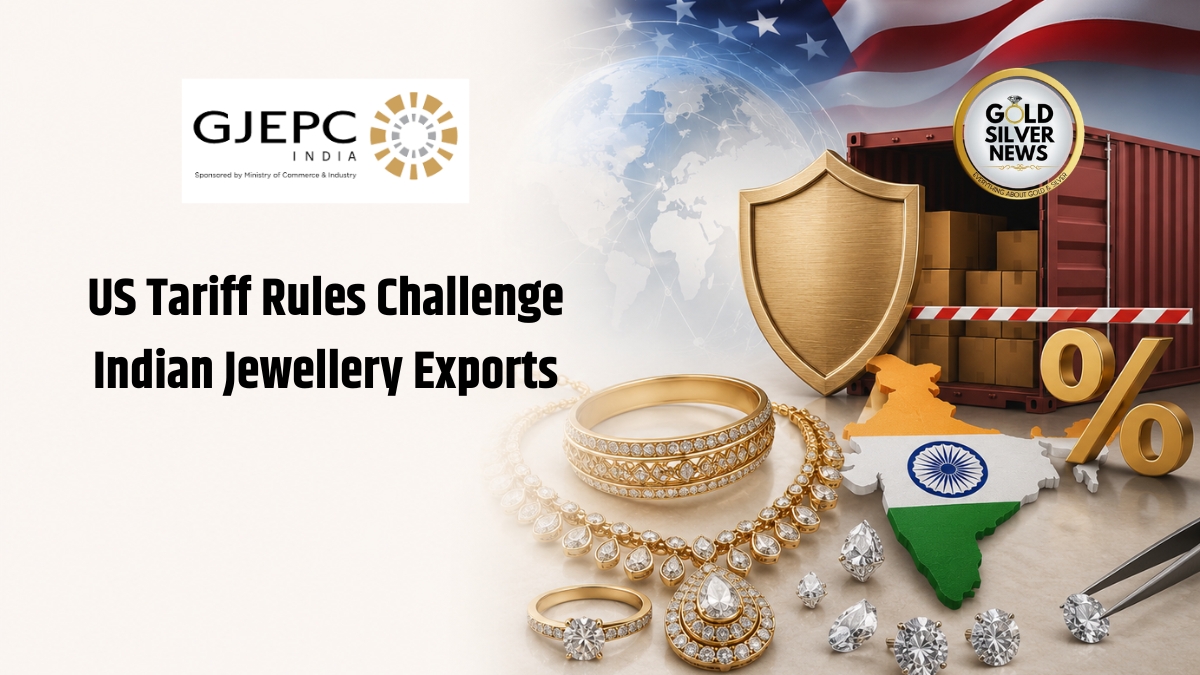
India’s gem and jewellery exports to the United States continue to face an additional 10% tariff as the US officially shifted from the temporary Section 122 balance-of-payments surcharge to the new Section 301 tariff regime on July 24, 2026. According to the Gem & Jewellery Export Promotion Council (GJEPC), while the tariff remains a challenge, India has secured a relatively stronger position than several competing export hubs.
Check out the latest Gold, Silver prices in MCX, International Market, Sarafa and your city on our new website– https://goldpricetodaynews.com/
The new tariff framework follows investigations by the Office of the United States Trade Representative (USTR) into how countries enforce bans on products linked to forced labour.
India Retains Lower Tariff Band
Although Indian exporters will continue paying the additional 10% tariff, India has been placed in the lower tariff category after introducing measures prohibiting imports made with forced labour.
This gives Indian jewellery exporters a 2.5 percentage-point tariff advantage over competing manufacturing and trading centres including China, Hong Kong, Thailand, Türkiye, the UAE, Israel, and Vietnam, which are now subject to an additional 12.5% tariff.
GJEPC Rejects Forced Labour Allegations
Shri Kirit Bhansali, Chairman, GJEPC, said, “At the outset, we categorically reject any implication that India’s gem and jewellery sector is linked to forced labour. Repeated studies have been commissioned that demonstrates the industry’s long-standing commitment to responsible sourcing, worker welfare, and ethical business practices. We also welcome the Government of India’s recent amendment to the Foreign Trade Policy that bars the import of goods produced, wholly or partly, with forced labour—an important step that reinforces India’s commitment to human rights and aligns our trade rules with internationally accepted labour standards.
“So imposing of 10% U.S. tariff under the new Section 301 regime, which is not at all justified, remains a challenge for India’s gem and jewellery exports, particularly as key competing trading centres in diamond continue to enjoy duty-free access for natural diamonds. While India’s placement in the lower tariff band offers some relative competitiveness in terms of jewellery, bridging the remaining tariff gap through an early India–U.S. Bilateral Trade Agreement and securing tariff relief for natural diamonds and coloured gemstones as provided to countries like EU, Malaysia remain our key priorities.”
Tariff Still Creates Export Challenges
Despite India’s relatively better tariff position, GJEPC said the new US policy continues to put pressure on exporters.
Jewellery shipments from India will still attract the existing Most Favoured Nation (MFN) duty of 5.5%–6%, along with the 10% Section 301 tariff, resulting in an effective import duty of around 15.5%–16%.
The Council also pointed out that:
- Natural diamonds processed in India continue to face the additional 10% tariff.
- Lab-grown diamonds and synthetic stones are also covered under the new tariff.
- Rough diamonds substantially transformed in India are treated as Indian-origin products and therefore remain subject to the Section 301 duty.
European Diamond Hub Retains Advantage
GJEPC highlighted that Belgium, a major global diamond trading centre within the European Union, continues to enjoy zero additional US tariff on natural diamonds.
This creates a pricing disadvantage for Indian exporters whose comparable products continue to attract the 10% additional duty.
GJEPC Calls for Early India-US Trade Agreement
GJEPC has reiterated that natural diamonds and coloured gemstones are critical raw materials for the jewellery manufacturing industry and should be considered for exemption from the additional tariff under Annex III.
The Council is actively engaging with the Government of India to pursue an early India–U.S. Bilateral Trade Agreement (BTA) to bridge the tariff gap and enhance the competitiveness of India’s gem and jewellery exports in the U.S. market.
About The Gem and Jewellery Export Promotion Council (GJEPC)
The Gem & Jewellery Export Promotion Council (GJEPC), set up by the Ministry of Commerce, Government of India (GoI) in 1966, is one of several Export Promotion Councils (EPCs) launched by the Indian Government, to boost the country’s export thrust, when India’s post-Independence economy began making forays in the international markets. Since 1998, the GJEPC has been granted autonomous status. The GJEPC is the apex body of the gems & jewellery industry and today represents 10900+ members in the sector. With headquarters in Mumbai, GJEPC has Regional Offices in New Delhi, Kolkata, Chennai, Surat and Jaipur, all of which are major centres for the industry. It thus has a wide reach and is able to have a closer interaction with members to serve them in a direct and more meaningful manner. Over the past decades, GJEPC has emerged as one of the most active EPCs and has continuously strived to both expand its reach and depth in its promotional activities as well as widen and increase services to its members.
FAQs
1. Why has the US imposed a 10% tariff on Indian gem and jewellery exports?
The tariff is part of the new Section 301 trade framework introduced after USTR investigations into forced labour import regulations across multiple countries.
2. Does India have any advantage under the new US tariff regime?
Yes. India falls under the 10% tariff band, while several competing countries, including China, Hong Kong, Thailand, Vietnam, and the UAE, face a higher 12.5% additional tariff.
3. What concerns has GJEPC raised about the new tariff policy?
GJEPC believes the continued 10% tariff increases export costs, reduces India’s competitiveness, and places Indian exporters at a disadvantage compared with countries enjoying duty-free access.
4. Which products remain affected by the additional US tariff?
Natural diamonds processed in India, coloured gemstones, lab-grown diamonds, synthetic stones, and jewellery exports continue to be covered under the additional Section 301 tariff.
5. What solution has GJEPC proposed?
GJEPC is urging the Indian government to finalize an India-US Bilateral Trade Agreement and seek tariff exemptions for natural diamonds and coloured gemstones to strengthen India’s export competitiveness.
Gold Price Today Digital Media Network
Facebook Page (129K Followers)- https://www.facebook.com/Goldsilverpricetoday
Facebook group of (80K Jewellers Member – Sunar Jewellers Ekta – https://www.facebook.com/groups/goldsilverpricenews
Website (100000 Users)- https://ohq.plp.mybluehostin.me/
Instagram (51K Followers)- https://www.instagram.com/goldpricetodaynews/
X- https://twitter.com/today_gold
Telegram Group (2000 Members)- https://telegram.me/goldsilverprice
Magazine (20000 Digital Subscribers): Gold Silver News For Magazine Subscription Contact +919111435279
Whatsapp News(25000 Members): +918448469588