



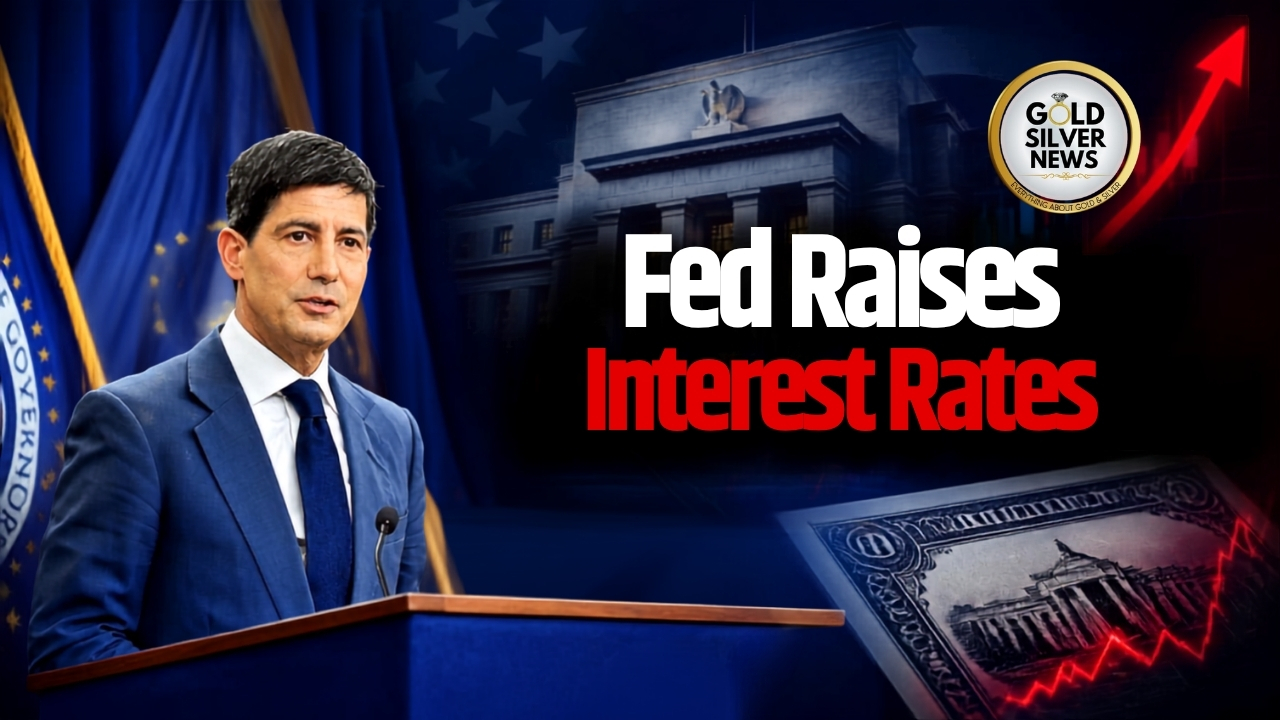
The US Federal Reserve has tightened monetary policy again, raising its benchmark interest rate as policymakers continue to deal with inflation that remains above their preferred level. The decision, announced after the September 15–16 FOMC meeting, lifted the federal funds target range to 3.75%–4% through a unanimous 12–0 vote.
Check out the latest Gold, Silver prices in MCX, International Market, Sarafa and your city on our new website–https://goldpricetodaynews.com/
The latest move marks the first Fed rate increase since 2023 and comes amid continued concerns over inflation and higher energy prices. The central bank also indicated that another rate increase could be possible, keeping markets focused on the future path of US monetary policy.
Fed Raises Rates by 25 Basis Points
The Federal Open Market Committee voted unanimously to increase the federal funds target range by 25 basis points, taking it to 3.75%–4%.
The Federal Reserve said economic activity was expanding at a solid pace, while inflation remained elevated. The central bank said the latest policy action was aimed at supporting a more timely return of inflation to its 2% target.
The decision comes as policymakers assess the impact of higher energy costs and other price pressures on the US economy.
Warsh Says Inflation Is Still Too High
Speaking after the policy meeting, Federal Reserve Chairman Kevin Warsh said inflation remains a major concern for policymakers and emphasized the importance of price stability.
“Our predominant focus is on the price stability side of our mandate,” he said. “The plain fact is that inflation is too high and has been for too long.”
The comments underline the Fed’s continued focus on controlling inflation even as officials assess economic growth and employment conditions.
Price Stability Remains a Key Fed Priority
Warsh also emphasized that stable prices are important for long-term economic growth.
“Price stability is foundational to economic growth, and I think we took an important step today to deliver it. We did it in part by removing the dose of accommodation that I mentioned before,” Warsh said.
The Fed’s latest economic projections show median PCE inflation at 3.7% for 2026, with the projection declining to 2.3% in 2027 and 2.1% in 2028.
Fed Says It Cannot Directly Control Individual Prices
Warsh acknowledged that monetary policy cannot directly determine the price of individual products such as oil or groceries. However, he said the central bank can work to prevent temporary price shocks from spreading across the wider economy.
“We cannot affect any individual price,” Warsh said, citing oil and groceries as two examples.
“But what we can do and will do is ensure that any change in relative prices don’t broaden out, don’t have second and third order effects on the economy,” he said. “That’s what we’re tasked to do, and that’s what we do.”
His comments came as energy prices have remained a significant source of inflation concerns.
Another Rate Hike Could Come in 2026
The Fed’s latest projections point to the possibility of another rate increase before the end of 2026. The median federal funds rate projection for the end of 2026 stands at 3.9%, compared with 3.4% in the June projections.
This means upcoming inflation, employment and economic-growth data will remain important for determining the timing and direction of future policy decisions.
Warsh Declines to Give Forward Guidance
Warsh said he would not provide specific details about the Fed’s future interest-rate decisions.
“I’m not in the forward guidance business,” he told reporters. “The decision we made today was a sober decision, serious decision, responsible decision, one that we have been preparing for and thinking about in my 110 or [120] days here.”
He also said the decision was based on the Fed’s assessment of economic conditions rather than market expectations.
“We made this decision today based on our assessment of the situation, based on our assessment of the trajectory for employment, based on our judgment on the strength of the economy, sometimes the market tries to prejudge our outcomes. I’ll observe market prices and see what they have to say. But today was our decision,” Warsh said.
White House Criticizes Fed Rate Hike
The White House criticized the Federal Reserve’s decision to raise interest rates, arguing that higher borrowing costs would not directly address inflation caused by energy-market pressures.
White House spokesman Kush Desai said the rate increase was not economically justified from the administration’s perspective.
“Today’s rather unfortunate decision by the Federal Reserve to hike interest rates was not, from the administration’s point of view, backed by a particularly compelling economic case,” Desai said in a Fox News interview.
Desai attributed current inflation pressures largely to energy supply issues and developments in the Middle East.
“To the extent that we still do have inflation, as the president and others have noted, it’s entirely driven by an energy supply shock, by what’s going on with oil prices in the Middle East,” Desai said. “These are things that have nothing to do with with interest rates and are not affected really by higher interest rates.”
He also said higher borrowing costs could weigh on economic activity.
“All higher interest rates are going to do right now is stymie the significant economic progress that the United States has made under this president.”
Desai said he had not personally spoken with Trump about the Fed’s decision.
What the Fed Decision Means for Gold and Silver
The latest Fed decision could remain an important driver for gold and silver prices. Higher US interest rates can influence the dollar and Treasury yields, while also increasing the opportunity cost of holding non-yielding assets such as gold.
At the same time, elevated inflation, geopolitical uncertainty and energy-market volatility can continue to influence safe-haven demand for precious metals.
The Fed’s economic projections show that inflation is expected to remain above the central bank’s 2% target in 2026 before moving closer to that level in subsequent years.
For bullion markets, investors will therefore continue to track the US Dollar Index, Treasury yields, crude oil prices, inflation data and further comments from Federal Reserve officials.
What Investors Should Watch Next
Following the September policy decision, attention will shift toward incoming economic data and signals from Federal Reserve officials. Inflation and employment reports will be particularly important in assessing whether policymakers maintain the current policy stance or consider another adjustment.
The Fed’s September projections also show that policymakers expect the federal funds rate to remain relatively elevated, although projections vary considerably among individual officials.
Markets will also continue to monitor developments in energy prices and geopolitical conditions, as these factors can influence inflation expectations and the broader economic outlook.
FAQ’s
1. Why did the Federal Reserve raise interest rates in September 2026?
The Federal Reserve raised its benchmark interest rate by 25 basis points to 3.75%–4% as inflation remained elevated. The FOMC approved the decision unanimously in a 12–0 vote, with the central bank saying the action would support a more timely return to its 2% inflation target.
2. What did Fed Chairman Kevin Warsh say about inflation?
Kevin Warsh said inflation remains too high and has stayed elevated for too long. He emphasized that price stability is a central priority for the Federal Reserve and said the latest policy action was intended to help prevent price shocks from creating broader inflationary effects.
3. Could the Fed raise interest rates again in 2026?
The Federal Reserve’s September economic projections indicate that another rate increase could be possible before the end of 2026. The median federal funds rate projection for the end of the year is 3.9%, although individual policymakers have different views about the appropriate policy path.
4. How could the Fed rate hike affect gold and silver prices?
Higher interest rates can support the US dollar and increase Treasury yields, potentially creating pressure on non-yielding assets such as gold and silver. However, persistent inflation, geopolitical uncertainty and energy-market volatility can also support safe-haven demand for precious metals.
5. What factors should investors watch after the latest Fed decision?
Investors should monitor upcoming US inflation and employment data, Treasury yields, the US Dollar Index, energy prices and comments from Federal Reserve officials. The Fed’s economic projections and future policy guidance will also remain important for understanding the potential direction of interest rates and financial markets.
Gold Price Today Digital Media Network
Facebook Page (129K Followers)- https://www.facebook.com/Goldsilverpricetoday
Facebook group of (80K Jewellers Member – Sunar Jewellers Ekta – https://www.facebook.com/groups/goldsilverpricenews
Website (100000 Users)- https://ohq.plp.mybluehostin.me/
Instagram (51K Followers)- https://www.instagram.com/goldpricetodaynews/
X- https://twitter.com/today_gold
Telegram Group (2000 Members)- https://telegram.me/goldsilverprice
Magazine (20000 Digital Subscribers): Gold Silver News For Magazine Subscription Contact +919111435279
Whatsapp News(25000 Members): +918448469588