



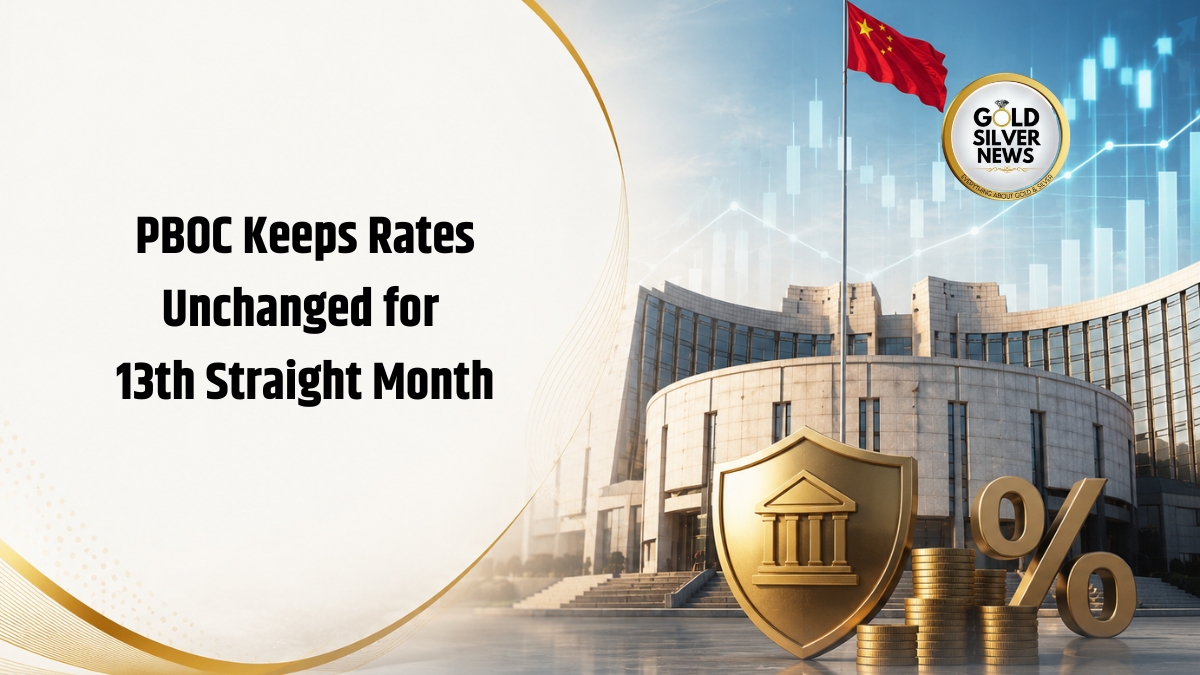
China’s central bank is holding its ground, signaling a patient, wait-and-see approach to its economic recovery. In a move that perfectly matched Wall Street and market expectations, China left its benchmark lending rates unchanged for the 13th consecutive month in June on Monday. The steady loan prime rates (LPRs) signal that authorities are in no immediate rush to inject aggressive monetary easing into the system, even as a broader economic divergence persists across the country.
The decision by the People’s Bank of China (PBOC), illustrated above at its Beijing headquarters, highlights a deliberate shift toward long-term restructuring rather than short-term credit expansion.
The Core Numbers
The central bank maintained its key benchmark rates exactly where they have sat for more than a year:
- The One-Year LPR: Kept steady at 3.00% (This rate typically influences corporate and household loans).
- The Five-Year LPR: Unchanged at 3.50% (This rate serves as the primary benchmark for residential mortgages).
This absolute pause was fully anticipated by the market. In a Reuters survey of 30 market participants conducted last week, 100% of respondents predicted no change to either of the two benchmark rates.
Economic Context: A Two-Speed Pattern
The decision to pause rate cuts comes amidst a visible “two-speed” growth pattern in the world’s second-largest economy. On one side, Chinese factories are being buoyed by surprisingly resilient export data. On the other side, domestic demand continues to struggle, heavily weighed down by a years-long property market downturn.
Data from May showed that new bank lending rose less than expected after contracting the previous month, showing that a prolonged property slump continues to stall household borrowing.
Addressing this dynamic at the annual Lujiazui Forum last week, PBOC Governor Pan Gongsheng explained that while loan growth has naturally slowed in recent years, bond and equity financing have steadily gained traction. Governor Pan described this evolution not as a policy failure, but as clear evidence of “profound economic restructuring” and the emergence of fresh growth engines.
What the Experts Say
Global market analysts believe that the underlying issue in China isn’t money supply, but rather the appetite for borrowing.
“We do not expect outright policy-rate cuts in the second half… The persistent issue facing the aggregate economy is not a shortage of liquidity supply, but a lack of credit demand,” noted Jing Sima, chief strategist at BCA Research. “Our base case is that fiscal policy becomes more supportive in the second half of the year, while the PBOC remains broadly accommodative but refrains from outright rate cuts.”
This sentiment of steady, incremental policy tweaks was mirrored across the region.
“Unless further evidence suggests that growth could slow below the official target of 4.5% to 5.0%, we think policy responses will be incremental,” added Ho Woei Chen, a leading economist at UOB.
FAQ’s
1. What decision did China’s central bank make regarding interest rates in June 2026?
The People’s Bank of China (PBOC) left its benchmark Loan Prime Rates (LPRs) unchanged for the 13th straight month. The one-year LPR remained at 3.00%, while the five-year LPR, which serves as the benchmark for mortgage loans, stayed at 3.50%. The move was widely expected by financial markets.
2. Why did the PBOC choose not to cut interest rates?
Chinese policymakers appear to believe that the main challenge facing the economy is not a lack of liquidity but weak demand for credit. Businesses and households remain cautious about borrowing, particularly due to ongoing concerns in the property sector. As a result, the central bank sees limited benefit in aggressive rate cuts at this stage.
3. What does the current economic situation in China look like?
China’s economy is showing a “two-speed” pattern. Export-oriented industries and manufacturing have remained relatively strong, supported by resilient overseas demand. However, domestic consumption, property investment, and household borrowing continue to face pressure, creating an uneven recovery across different sectors of the economy.
4. How does this decision reflect China’s broader economic strategy?
The PBOC’s decision highlights a growing focus on long-term structural reforms rather than short-term stimulus measures. Officials argue that slower loan growth is partly the result of economic transformation, with bond and equity financing playing a larger role in supporting businesses and investment than in previous years.
5. What are economists expecting from China’s policy outlook in the second half of 2026?
Most economists do not expect major interest-rate cuts in the coming months unless economic growth weakens significantly below the government’s target range of 4.5% to 5.0%. Instead, analysts anticipate gradual policy adjustments, increased fiscal support, and a broadly accommodative monetary stance aimed at maintaining stability while encouraging sustainable growth.
Gold Price Today Digital Media Network
Facebook Page (129K Followers)- https://www.facebook.com/Goldsilverpricetoday
Facebook group of (80K Jewellers Member – Sunar Jewellers Ekta – https://www.facebook.com/groups/goldsilverpricenews
Website (100000 Users)- https://ohq.plp.mybluehostin.me/
Instagram (51K Followers)- https://www.instagram.com/goldpricetodaynews/
X- https://twitter.com/today_gold
Telegram Group (2000 Members)- https://telegram.me/goldsilverprice
Magazine (20000 Digital Subscribers): Gold Silver News For Magazine Subscription Contact +919111435279
Whatsapp News(25000 Members): +918448469588