
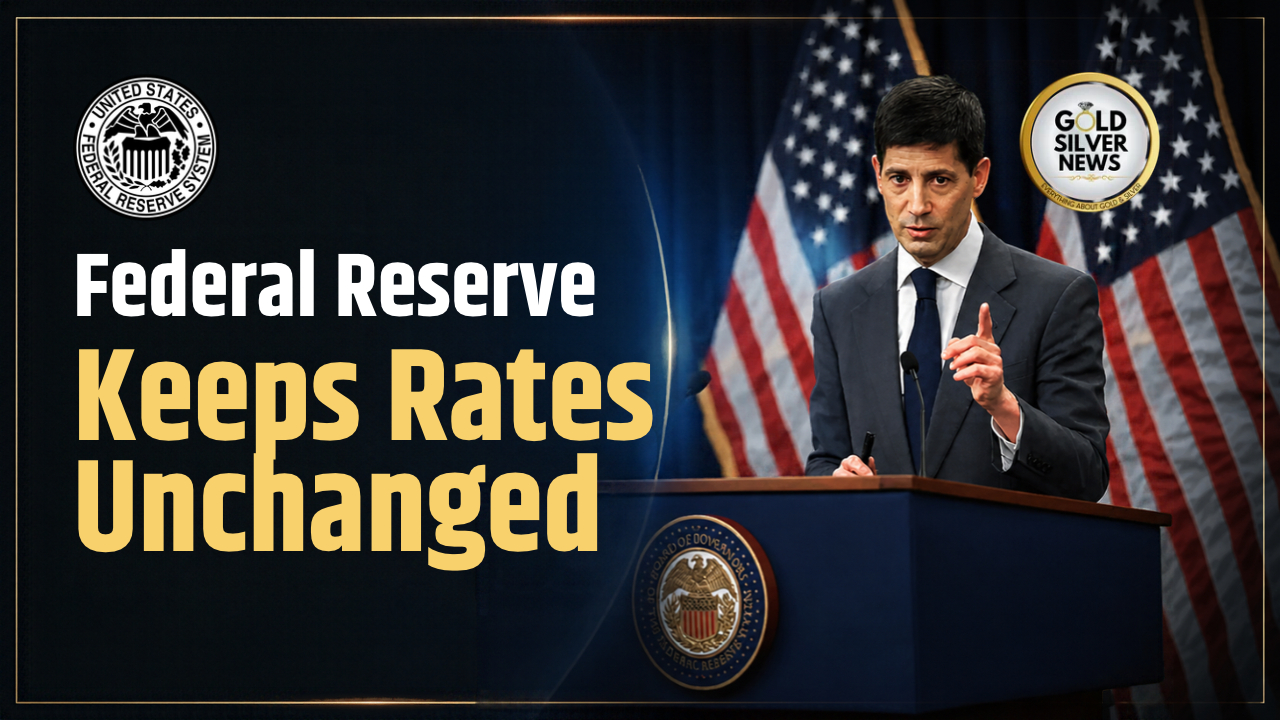
The US Federal Reserve kept its benchmark interest rate unchanged on Wednesday, maintaining the target range at 3.75%–4.00%. The widely anticipated decision reflects the central bank’s cautious approach as it waits for more inflation and economic data before considering further changes to borrowing costs.
Check out the latest Gold, Silver prices in MCX, International Market, Sarafa and your city on https://goldpricetodaynews.com/
The decision also delays the next potential policy move until after the US midterm elections scheduled for November 3. The Federal Open Market Committee (FOMC) voted 10–2 to maintain rates, while upgrading its assessment of the economy’s performance. The central bank now describes economic activity as growing at a “strong pace.”
Fed Chair Kevin Warsh expressed confidence that inflation could return to the central bank’s 2% target without deliberately slowing economic growth or increasing unemployment.
Fed Wants More Data Before Its December Policy Decision
The Federal Reserve’s latest statement highlighted the need to assess additional economic information before deciding on its next policy move. Inflation, the central bank noted, “remains elevated,” while concerns persist that price pressures could spread across different parts of the economy.
Between now and the next policy meeting in December, “the accumulation of more information will help the Committee determine the policy stance appropriate to ensure a timely return of inflation to the Committee’s 2% goal,” the FOMC said. “The Committee will deliver price stability.”
The statement also indicated that further rate increases could remain an option if inflation does not ease sufficiently. Some policymakers are concerned that strong consumer spending and demand associated with artificial intelligence investment may continue pushing prices higher.
The decision followed a quarter-percentage-point rate increase approved in September. Senior Fed officials had signalled that there was no immediate urgency to raise rates again, although subsequent inflation data came in stronger than forecast.
Kevin Warsh Expects Strong US Economic Growth
Speaking after the conclusion of the Fed’s two-day policy meeting, Warsh said he expected Thursday’s third-quarter gross domestic product report to show strong investment and consumer spending. He also anticipated that economic growth had accelerated compared with the first half of the year.
However, Warsh said he did not believe the economy was overheating or generating excessive demand-driven inflation that needed to be curbed immediately.
“The economy is pointing in the right direction. Is the economy running too hot? Is the economy running too strong? That isn’t the judgment of most of my colleagues,” said Warsh, arguing, as he has before, that changes in productivity, even predating the artificial intelligence boom, may allow the US to grow faster without as much inflation.
He also emphasised that controlling inflation should not require unnecessary damage to employment or economic activity.
“The goal, in my view … isn’t to throw sand in the gears of the economy and throw people out of work. I don’t think we have to do that.”
Warsh said the existing policy rate was already affecting financial conditions through somewhat tighter credit availability. This could slow business investment and may have contributed to recent stock market declines. If weaker markets reduce spending among wealthier households, that could also help ease inflationary pressures.
US Treasury Secretary Scott Bessent, speaking to CNBC on Thursday, said the administration continued to have faith that Warsh would “find the right balance” between the 2% inflation goal and continued economic growth.
Two Fed Policymakers Dissent Over the Interest Rate Decision
The decision to maintain rates was not unanimous. Fed Governor Lisa Cook, who is currently being targeted by President Donald Trump for removal from the central bank, opposed the decision and favoured a quarter-percentage-point rate increase. It was her first dissent on a central bank policy decision.
Cleveland Fed President Beth Hammack, who has consistently taken a hawkish position on monetary policy, also supported raising rates.
Financial markets reacted modestly to the announcement. US stocks gave up some gains immediately after the decision but ended the day higher. Longer-dated US Treasury yields continued rising, while short-term interest-rate futures edged higher as traders slightly reduced their expectations for upcoming rate increases.
Michael Pearce, chief US economist at Oxford Economics, said the conditions keeping policymakers concerned about inflation remained in place.
“The forces keeping the Federal Reserve hawkish haven’t faded. Diesel and gasoline prices remain elevated, AI-driven inflation isn’t easing, and the labor market remains resilient,” he said.
High Energy Costs and Inflation Remain Major Concerns
The Fed’s decision came despite continued pressure from energy prices and stronger-than-expected inflation data. Diesel and gasoline costs remain elevated, with diesel serving as a key input for shipping, agriculture and other industries.
Inflation and the cost of living have also become central issues ahead of the November 3 US midterm elections. The vote will determine whether Trump’s Republican Party retains control of both chambers of Congress or whether Democrats gain leadership positions and stronger oversight powers, including over the Federal Reserve.
During both his first and second terms in the White House, Trump has criticised the Fed for failing to deliver substantial interest rate cuts. Following the September rate increase, he described Warsh’s policymaking colleagues as “hostile” and “partisan.”
Warsh told reporters on Wednesday that politics played no role in the decision to leave rates unchanged, indirectly responding to Trump’s allegations of bias within the central bank.
Markets Expect a Possible Rate Hike in December
Although the Fed decided against another increase in October, markets continue to anticipate the possibility of further tightening over the coming months.
Market pricing indicated approximately an 80% probability of a rate hike at the December 8–9 meeting, with another increase in borrowing costs considered likely by March. These expectations had eased slightly following Warsh’s press conference.
Inflation remains around one percentage point above the Fed’s 2% target and has shown little progress in recent months. The central bank has missed its inflation target for more than half a decade, raising concerns that businesses and households may have become accustomed to faster price increases.
If companies and consumers begin making pricing, wage and spending decisions based on expectations of persistently high inflation, bringing price growth back to the target could become more difficult.
For now, the Federal Reserve is waiting for more evidence before determining its next move. Inflation trends, economic growth, consumer demand and energy prices are likely to remain central to the debate ahead of the December policy meeting.
FAQ’s
1. Why did the US Federal Reserve keep interest rates unchanged in October 2026?
The Federal Reserve maintained its benchmark rate at 3.75%–4.00% while waiting for more information on inflation and economic conditions. Although the economy is growing at a strong pace, inflation remains above the central bank’s 2% target, leaving policymakers cautious about their next move.
2. Which Fed officials supported raising interest rates instead of holding them steady?
Fed Governor Lisa Cook and Cleveland Fed President Beth Hammack dissented from the decision. Both favoured a quarter-percentage-point rate increase rather than maintaining the existing interest rate range.
3. What are markets expecting from the Federal Reserve in December 2026?
Market pricing indicated approximately an 80% probability of a rate increase at the December 8–9 meeting. Markets were also anticipating the possibility of another increase by March, although these expectations could change as new economic data becomes available.
4. How are energy prices and consumer spending affecting the Fed’s inflation outlook?
Elevated diesel and gasoline prices are increasing costs for shipping, agriculture and other industries. Meanwhile, resilient consumer spending, artificial intelligence-related demand and a strong labour market are adding to concerns that inflation could remain above target.
5. Does the Fed’s decision to hold rates mean borrowing costs will remain unchanged?
No. The October decision does not guarantee that rates will remain unchanged at future meetings. The Fed plans to assess additional information before its December meeting, and persistent inflation could lead policymakers to consider another rate increase.
Our Digital Media Network
Gold Price Today News Website
https://goldpricetodaynews.com/
YouTube — Gold Price Today News 198K+ Subscribers
https://www.youtube.com/@GoldPriceTodayNews
Facebook Page — Gold Silver Price Today 174K+ Followers
https://www.facebook.com/Goldsilverpricetoday
Instagram — Gold Price Today News 70K+ Followers
https://www.instagram.com/goldpricetodaynews/
Virendra Vyas — Personal Instagram 10K+ Followers
https://www.instagram.com/virendra1711/
Facebook Community — Gold Silver Price News 82K Jewellers & Industry Community Members
https://www.facebook.com/groups/goldsilverpricenews
Gold Silver News Magazine — Print & Digital Edition
https://goldpricetodaynews.com/magazine
Follow our Google Profile
https://profile.google.com/@goldpricetodaynews