



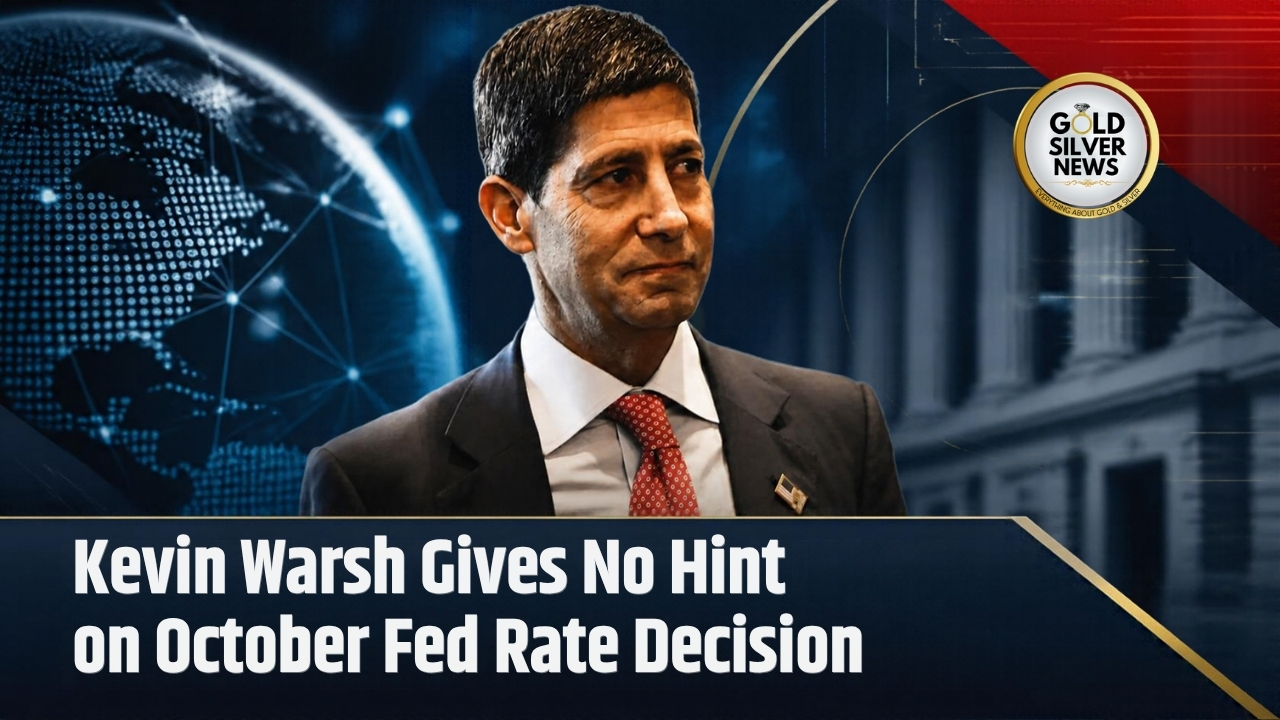
Federal Reserve Chairman Kevin Warsh has declined to indicate whether the US central bank will raise interest rates again in October, as policymakers worldwide face persistent inflation, rising energy costs and mounting economic uncertainty. While emphasising the importance of data-driven decisions, Warsh also highlighted the transformative potential of artificial intelligence (AI), warning that its economic benefits may come with a difficult transition. Speaking at a fireside chat with International Monetary Fund (IMF) Managing Director Kristalina Georgieva during the IMF-World Bank Annual Meetings in Bangkok on Friday, Warsh defended his approach of avoiding advance signals about monetary policy decisions.
Check out the latest Gold and Silver prices in MCX, the international market, Sarafa and your city on https://goldpricetodaynews.com/
Kevin Warsh Refuses to Signal October Federal Reserve Interest Rate Decision
Warsh reiterated that he does not believe in announcing policy decisions before Federal Reserve meetings, arguing that financial markets should assess incoming economic data rather than depend on advance guidance from policymakers.
“I don’t prejudge meetings. I don’t believe in saying now what I might do at the meetings that we have in the balance of this year,” Warsh said.
He acknowledged that his position could disappoint investors looking for clues ahead of the Fed’s next meeting later this month. However, he indicated that the central bank is taking a different approach to communicating its policy outlook.
“It’s a new chapter at the Fed [and] we’re not in that business anymore. But we can go in any direction you’d like,” he said.
His remarks leave investors without a clear indication of whether the Federal Reserve will raise interest rates, keep them unchanged or consider another policy adjustment at its upcoming meeting.
Global Central Banks Face Synchronous Monetary Tightening
Warsh also pointed to a broad shift towards tighter monetary policy across major economies, describing inflation control as a challenge shared by central banks worldwide.
Although individual central banks operate under different mandates and make independent policy decisions, their efforts to address rising prices are increasingly moving in the same direction.
Warsh described the trend as “a synchronous tightening in monetary policy in most places around the world,” adding that “there’s no free riders.”
The comments underline how inflation has become a shared concern for policymakers as higher energy costs, geopolitical tensions and strong investment demand put pressure on prices and borrowing costs.
The global economic outlook is also complicated by rising public debt. Global public debt is projected to exceed 100% of worldwide gross domestic product (GDP), a threshold last reached in the aftermath of World War II.
The United States government has argued that stronger economic growth would help manage its rising debt burden. However, the IMF has warned against relying on economic growth alone to resolve the country’s fiscal challenges.
Energy Costs and AI Investment Add to Global Inflation Pressures
Rising energy prices linked to the Iran war, combined with the investment boom in artificial intelligence, are adding to inflationary pressures and increasing borrowing costs across the global economy.
These developments present a challenge for central banks, which must control inflation without unnecessarily weakening economic growth. Higher interest rates can help contain price pressures, but they can also increase borrowing costs for households, businesses and governments.
The situation is particularly complicated by the growing burden of public debt. With global debt approaching levels not seen since the aftermath of World War II, policymakers face increasing pressure to maintain economic stability while managing financing costs.
The US government has maintained that strong economic growth can help reduce the strain of rising debt. However, the IMF has cautioned that growth alone may not be sufficient to address the country’s fiscal challenges.
Kevin Warsh Optimistic About AI but Warns of a Difficult Transition
Alongside his concerns about inflation and monetary policy, Warsh expressed optimism about the long-term economic potential of artificial intelligence.
He believes economies that successfully integrate AI could experience higher productivity and greater wealth creation. However, he cautioned that the transition may be uneven and that the technology’s near-term impact on employment remains uncertain.
“I want you to hear from me optimism, but optimism leavened by the seriousness of purpose,” Warsh said.
Warsh suggested that the significance of the current technological transformation would become clearer over time. He expects AI to have a lasting influence on the global economic landscape.
A decade from now, he said, people will look back on the developments and “say this was hugely consequential.”
His remarks highlight the balance between recognising AI’s potential to improve productivity and preparing for possible disruptions to employment and business activity. The pace at which companies adopt AI and translate technological advances into measurable productivity gains will remain an important factor in assessing its economic impact.
Stock Market Reaction to Kevin Warsh’s Remarks
Financial markets showed a relatively measured response following Warsh’s comments in Bangkok.
S&P 500 and Nasdaq futures edged higher after the speech, while Asian stock market indexes and US Treasury yields remained largely stable.
Warsh’s refusal to provide advance guidance meant investors received no fresh confirmation about the Federal Reserve’s next interest-rate move. Market participants will continue to assess economic releases, inflation trends and employment figures to determine the likely direction of US monetary policy.
The absence of a clear signal also reinforces the importance of upcoming economic data in shaping expectations for the remainder of the year.
Fed Rate Outlook: September Hike and October Meeting in Focus
The Federal Reserve raised its benchmark interest rate to a range of 3.75% to 4% last month, marking its first rate increase since 2023.
According to CME FedWatch data cited in the report, traders see a 72.3% probability that the Fed will leave interest rates unchanged at its October 27–28 meeting. Meanwhile, most market participants expect a 25-basis-point rate increase at the December meeting.
These expectations reflect continued uncertainty over inflation, energy prices, economic growth and the consequences of the global investment boom in AI.
However, market probabilities are not official Federal Reserve decisions and can change as new economic information becomes available.
Warsh’s latest remarks suggest that investors should not expect advance assurances about the Fed’s next move. Instead, the direction of monetary policy will depend on how economic conditions develop and how policymakers evaluate the balance between inflation risks and growth prospects.
What Lies Ahead for the Global Economy and Fed Policy?
Warsh’s comments highlight two major considerations for the economic outlook: the potential for AI-driven productivity growth and the continuing challenge of controlling inflation.
While stronger investment could support long-term growth, uncertainty over employment and the near-term effects of AI means the transition may be uneven. At the same time, persistent price pressures could complicate the Federal Reserve’s decisions on interest rates.
For now, Warsh has avoided signalling the outcome of the next policy meeting. Investors and businesses will be watching incoming economic data and further central bank commentary to assess the outlook for inflation, employment, economic growth and US monetary policy.
FAQ’s
1. What did Kevin Warsh say about AI’s impact on the global economy?
Warsh said AI could become one of the most consequential economic changes of his lifetime, potentially boosting productivity and wealth. However, he cautioned that the transition could be uneven and its near-term employment effects remain uncertain.
2. Why does Kevin Warsh believe AI could create uncertainty in the job market?
AI is expected to change how businesses operate and how demand and supply evolve. Warsh said its impact on employment over the next 12 to 18 months remains unclear as companies and workers adapt to the technology.
3. What concerns did Warsh highlight about inflation and global investment?
Warsh described the investment surge as a major positive development for the global economy but noted that rising prices remain a concern among central bankers. Policymakers must balance the benefits of economic growth with the need to maintain price stability.
4. Did Kevin Warsh indicate the Federal Reserve’s next interest-rate decision?
No. Warsh declined to prejudge upcoming policy meetings or announce his position in advance. He reiterated the Federal Reserve’s commitment to price stability but provided no clear signal about its next interest-rate decision.
5. How could artificial intelligence influence future monetary policy decisions?
AI could increase productivity and expand economic output over time, but its effects on employment, demand, supply and inflation remain uncertain. The Federal Reserve will need to assess these developments alongside economic growth and price data when making policy decisions.
Our Digital Media Network
Gold Price Today News Website
https://goldpricetodaynews.com/
YouTube — Gold Price Today News 196K+ Subscribers
https://www.youtube.com/@GoldPriceTodayNews
Facebook Page — Gold Silver Price Today 174K+ Followers
https://www.facebook.com/Goldsilverpricetoday
Instagram — Gold Price Today News 70K+ Followers
https://www.instagram.com/goldpricetodaynews/
Virendra Vyas — Personal Instagram 10K+ Followers
https://www.instagram.com/virendra1711/
Facebook Community — Gold Silver Price News 82K Jewellers & Industry Community Members
https://www.facebook.com/groups/goldsilverpricenews
Gold Silver News Magazine — Print & Digital Edition
https://goldpricetodaynews.com/magazine
Follow our Google Profile
https://profile.google.com/@goldpricetodaynews