



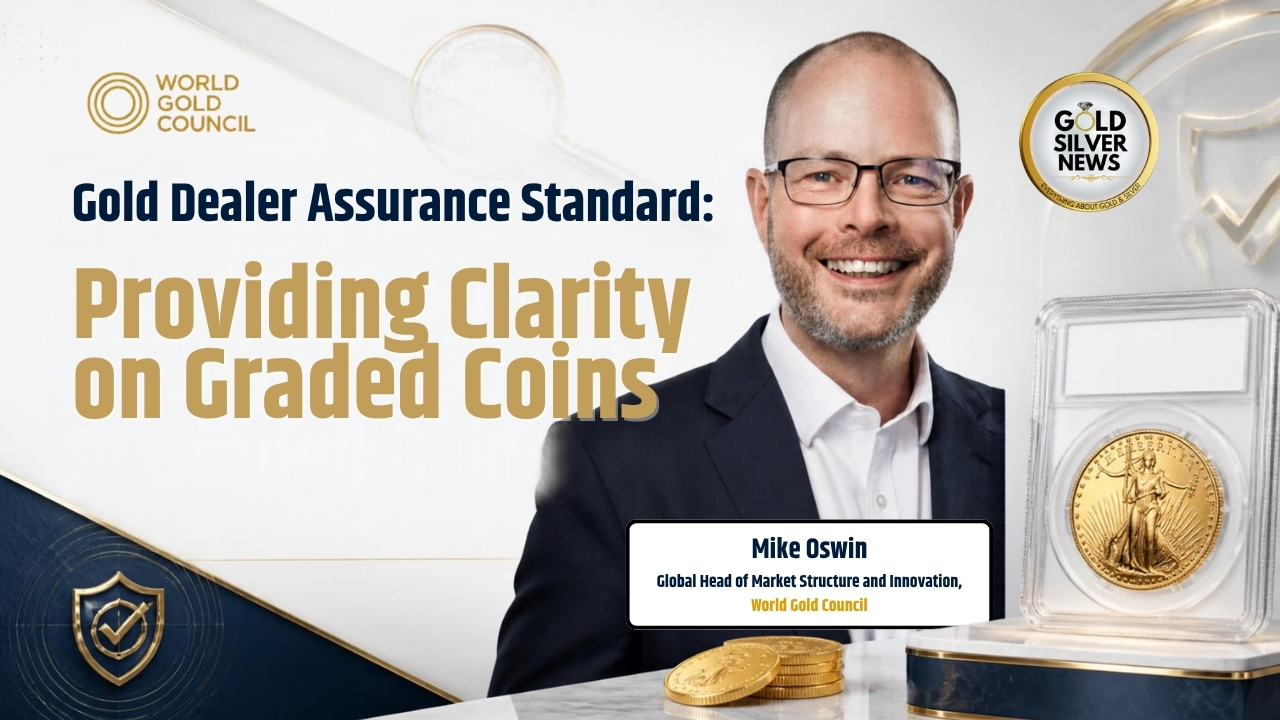
As retail gold investment products continue to evolve, clearer communication between dealers and customers is becoming increasingly important. Questions around the pricing, grading and resale value of gold coins have prompted further discussion within the industry. According to an article by Mike Oswin, Global Head of Market Structure and Innovation at WGC, the Gold Dealer Assurance Standard (GDAS)™ has provided clarification on how graded coins should be presented to customers under a standard designed to support trust, transparency and customer confidence.
Check the latest rates for gold and silver—including MCX, international market, and bullion prices, as well as rates in your city—on our new website: https://goldpricetodaynews.com/
GDAS Highlights Need for Greater Clarity on Graded Coins
Since the launch of the Gold Dealer Assurance Standard (GDAS)™, there has been discussion around how graded coins should be treated under a standard designed to support trust, transparency and customer confidence.
The issue has become increasingly relevant as a segment of graded coins has emerged where the selling proposition can depend less on the defining characteristics of the coin itself and more on how gold dealers describe and position these products to customers.
The standard emphasises that customers should have sufficient information to understand what they are purchasing and what grading means for the value and resale prospects of a coin.
Numismatic and Collectible Coins Have Different Value Drivers
Numismatic and collectible gold coins represent a legitimate segment of the gold market and can also be offered as investment products. Unlike conventional retail gold investment coins, their value may depend on factors such as rarity, condition, provenance and collector demand.
For mainstream bullion coins, however, the price is generally linked more closely to the amount of gold contained in the product.
This distinction becomes important when the term “graded coins” is used because grading can apply to coins that otherwise remain conventional bullion products.
Grading Does Not Change a Coin’s Gold Content
A common bullion coin does not automatically become a fundamentally different investment product simply because it has received a grading certificate.
The coin’s gold content remains unchanged, while a grading certificate does not provide a guarantee that a buyer will recover any additional premium paid when the coin is eventually resold.
Therefore, the GDAS discussion places particular emphasis on making the distinction between the physical gold value of a coin and any additional premium associated with its grading or collectibility.
Gold Dealers Should Clearly Explain Grading to Customers
Transparency is a central consideration when dealers offer coins accompanied by grading certificates.
Customers should be clearly informed about:
- What the grading process means
- Who awarded the grade
- What the grade does and does not indicate about the coin’s value
- Whether the coin’s intrinsic gold value has changed
- The possibility that a premium paid for grading may not be recovered during resale
The standard stresses that grading does not increase the intrinsic gold value of a coin. Any additional premium attached to a graded product may depend on market demand and other factors and may not necessarily be recovered when the coin is sold.
GDAS Does Not Aim to Blur the Line Between Bullion and Collectibles
The Gold Dealer Assurance Standard is not intended to legitimise practices that blur the distinction between bullion products and collectibles.
In particular, the standard does not seek to support situations where ordinary bullion coins or rounds are marketed as rare or unusually valuable solely because they have been graded.
At the same time, the standard is not intended to exclude legitimate gold dealers that offer graded coins in a transparent and responsible manner.
Grading remains an important characteristic within the numismatic and collectibles market, where factors beyond gold content can influence a coin’s value.
Graded Coins to Face Transparency Checks During GDAS Audits
The treatment of graded coins can become particularly relevant when a gold dealer undergoes an audit to assess compliance with the Gold Dealer Assurance Standard.
According to the guidance, assessments should look beyond simply checking whether disclosures are present. They should also consider whether the information provided to customers is clear, prominent and consistently communicated at the point of sale.
This means that the manner in which a dealer presents information about grading, premiums and potential resale value can be an important part of the assessment.
GDAS Welcomes Market Feedback
GDAS is a new standard, and feedback from market participants remains part of its ongoing development. The guidance indicates that if certain wording can be made clearer without weakening customer protection, such feedback can be considered as the Standard evolves.
The underlying principle remains focused on fair and transparent treatment of customers. Graded coins can have a legitimate place within the retail gold market, but customers should not be given the impression that grading alone transforms an ordinary bullion product into a rare investment.
Similarly, customers should not be led to believe that a premium paid for a graded coin today will necessarily be recovered when the product is sold in the future.
Transparency Remains Central to Gold Dealer Assurance
The discussion around graded coins highlights the importance of ensuring that customers understand the difference between gold value, collectible value and grading-related premiums.
The industry has been invited to continue engaging with the Gold Dealer Assurance Standard and provide feedback. The Standard is expected to be reviewed and enhanced as market practices and customer expectations develop.
GDAS Aims to Strengthen Trust in the Gold Market
The Gold Dealer Assurance Standard (GDAS)™ has been introduced as the first global best-practice framework specifically designed for retail and wholesale gold dealers operating in the retail gold market. Developed by the World Gold Council (WGC) in consultation with industry participants and with support from the British Standards Institution (BSI), the Standard is intended to help dealers strengthen customer confidence in their gold products and services.
Gold Dealer Assurance Programme to Provide Independent Assessment
Following the planned launch of the Gold Dealer Assurance Programme (GDAP)™ later this year, BSI will provide gold dealers with the opportunity to undergo an assessment against the Standard.
The assessment will be voluntary and independent and is intended to provide customers with greater confidence that participating dealers are following high standards across key areas of their business.
The Standard covers the following eight areas:
- Fairness and Integrity
- Transparency
- Protection of Customer Assets
- Regulatory Compliance
- Responsible Gold Sourcing
- Commercial Prudence
- Operational Professionalism
- Vaulted Gold Products and Services
Dealers interested in participating can register their interest through the instructions provided by the World Gold Council.
The Standard helps build Trust
Retail investment has historically represented approximately 25% of global gold demand. However, research sponsored by the World Gold Council found that experienced investors across six countries reported concerns about trust in gold dealers and gold products.
The research also found that a majority of surveyed investors believed there was a shortage of reliable education about gold. The Gold Dealer Assurance Standard has been developed in part to help address these gaps by establishing a structured framework for dealer practices and customer confidence.
To share Your Feedback
Market participants across the retail gold investment industry are encouraged to share their valuable feedback and perspectives. The Standard will continue to be reviewed and enhanced as the industry evolves. Further information about the Standard is available here: https://www.gold.org/gold-standards/gold-dealer-assurance-standard.
FAQ’s
1. What is the Gold Dealer Assurance Standard (GDAS)™?
The Gold Dealer Assurance Standard (GDAS)™ is designed to support trust, transparency and customer confidence in the retail gold market. It establishes expectations around how gold dealers communicate with customers and seeks to promote fair and transparent practices when gold investment products are offered for sale.
2. Does grading increase the intrinsic gold value of a bullion coin?
No. Grading does not change the amount of gold contained in a bullion coin. A grading certificate may provide information about the coin’s condition or characteristics, but it does not increase its intrinsic gold value. Any additional premium associated with grading may also not be recovered when the coin is resold.
3. What information should gold dealers provide when selling graded coins?
Dealers should clearly explain what the grading means, who awarded the grade and what the grade does and does not imply about the coin’s value. Customers should also understand that grading does not increase intrinsic gold value and that any premium paid for a graded coin may not necessarily be recovered during resale.
4. How are graded bullion coins different from numismatic and collectible gold coins?
Numismatic and collectible coins can derive value from factors such as rarity, condition, provenance and collector demand, in addition to their gold content. For mainstream bullion coins, value is generally more closely associated with the underlying gold content. A grading certificate alone does not automatically turn a common bullion coin into a rare collectible.
5. How will GDAS assess dealers that sell graded gold coins?
During an audit against the Gold Dealer Assurance Standard, assessments are expected to consider not only whether customer disclosures exist but also whether they are clear, prominent and consistently communicated at the point of sale. The objective is to ensure customers receive transparent information about grading, value and potential premiums.
Gold Price Today Digital Media Network
Facebook Page (129K Followers)- https://www.facebook.com/Goldsilverpricetoday
Facebook group of (80K Jewellers Member – Sunar Jewellers Ekta – https://www.facebook.com/groups/goldsilverpricenews
Website (100000 Users)- https://ohq.plp.mybluehostin.me/
Instagram (51K Followers)- https://www.instagram.com/goldpricetodaynews/
X- https://twitter.com/today_gold
Telegram Group (2000 Members)- https://telegram.me/goldsilverprice
Magazine (20000 Digital Subscribers): Gold Silver News For Magazine Subscription Contact +919111435279
Whatsapp News(25000 Members): +918448469588