
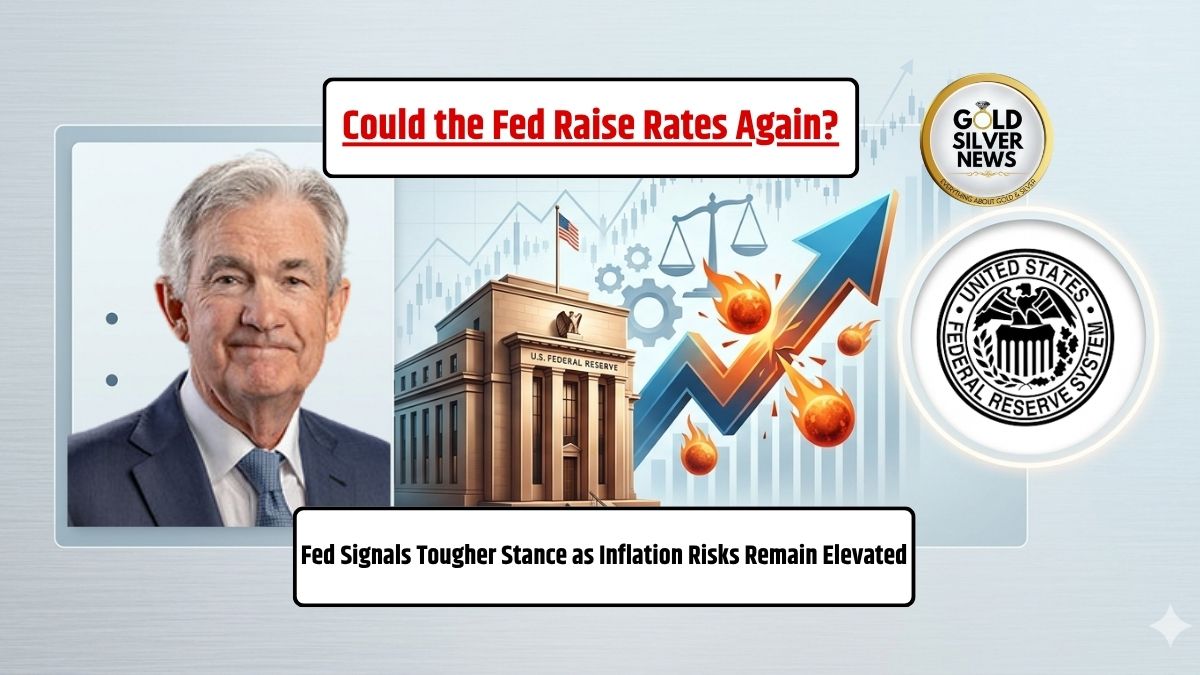
Fed Meeting Minutes: The global financial ecosystem faces an abrupt monetary policy realignment as a majority of Federal Reserve officials officially warned that the central bank may need to consider raising interest rates if inflation remains persistently above its 2% target. According to the minutes of the April 28–29 Federal Open Market Committee (FOMC) meeting, a dominant bloc of policymakers advocated for completely dropping the central bank’s long-standing easing bias. The record signals a profound shift in market realities, establishing that the Fed’s next strategic move could potentially be an interest rate hike rather than a cut—a stark departure from the beginning of the year when multiple rate cuts were projected for 2026.
The Geopolitical Catalyst: The Iran War and Sticky Inflation
The Federal Reserve’s intensifying hawkish stance reflects deepening institutional anxiety over the economic collateral of the ongoing war with Iran. With the Strait of Hormuz remaining effectively blocked, a worsening inflation outlook has locked central bank officials into a high-stakes battle against supply-side shocks.
- Prolonged Inflation Timelines: The vast majority of participants noted an increased risk that core price pressures will take significantly longer to return to the committee’s 2% objective than previously modeled.
- The Growth vs. Inflation Debate: Stronger-than-expected employment figures and accelerating inflation indicators have reinforced the notion that structural price pressures pose a far greater economic threat than a localized downturn in manufacturing or industrial activity.
- Middle East Asset Drivers: Fed staff specifically noted in their financial review that the conflict in the Middle East has cemented itself as the primary factor driving global asset price movements, skewing near-term inflation expectations to the upside.
What did the Fed Meeting Minutes Reveal?
- A majority of Federal Reserve officials warned that the U.S. central bank may need to consider raising interest rates if inflation continues to remain above its 2% target.
- According to the April 28–29 FOMC meeting minutes, many policymakers supported removing the Fed’s easing bias, signaling that the next policy move could potentially be a rate hike instead of a rate cut.
- Most Fed officials expressed concern that inflation may take longer than previously expected to return to the central bank’s 2% target.
- Policymakers continued to debate the economic impact of the ongoing Iran war and rising geopolitical tensions in the Middle East.
- A growing number of officials disagreed with the Federal Reserve’s previous dovish stance, while only one member favored an immediate quarter-point rate cut.
- The Federal Reserve noted that the Middle East conflict remains a major factor influencing global asset prices and financial markets.
- U.S. equity markets recovered from earlier losses, but yields on 2-year and 10-year U.S. Treasury bonds moved slightly higher after the meeting.
- Near-term inflation expectations also increased during the intermeeting period, adding to concerns about persistent price pressures in the U.S. economy.
- The meeting minutes suggest that the possibility of future Fed rate hikes has increased if inflation does not cool down in the coming months.
Inside the April FOMC Gridlock: Dropping the Easing Bias
At the April gathering, the FOMC elected to leave its benchmark federal funds rate unchanged in a range of 3.50% to 3.75%. However, the internal record exposes growing friction within the committee regarding post-meeting forward guidance.
Many participants explicitly stated they would have preferred removing the dovish language from the official policy statement that hinted at an eventual resumption of rate cuts. Three hawkish policymakers formally dissented against the statement’s phrasing, arguing that “some policy firming would likely become appropriate” if inflation metrics refused to cool. Conversely, only one dovish member dissented in favor of an immediate quarter-point rate cut, illustrating the near-total collapse of the Fed’s accommodative coalition.
A Baptism of Fire for Incoming Chair Kevin Warsh
The unfolding macroeconomic turmoil creates a highly volatile backdrop for incoming Federal Reserve Chair Kevin Warsh, who is scheduled to be officially sworn in by U.S. President Donald Trump during a White House ceremony this Friday.
Trump has previously made it clear that a willingness to reduce interest rates was a primary factor in his administrative selections. However, during his Senate confirmation hearing, Warsh firmly denied that the president had demanded any rate-cutting concessions, pledging to fiercely protect the independence of the Fed’s rate-setting mechanism from executive branch interference.
FAQ’s
1. What did the latest Fed meeting minutes reveal?
The April 28–29 FOMC meeting minutes showed that many Federal Reserve officials are increasingly concerned about persistent inflation and believe future interest rate hikes may become necessary if price pressures fail to ease toward the Fed’s 2% target.
2. Why is the Federal Reserve becoming more hawkish?
The Fed’s hawkish shift is mainly driven by rising inflation risks, strong labor market data, elevated energy prices, and geopolitical tensions caused by the ongoing Iran conflict, which are increasing uncertainty across global financial markets.
3. Did the Federal Reserve change interest rates in the April meeting?
No, the Federal Reserve kept its benchmark interest rate unchanged at 3.50%–3.75%. However, the meeting minutes indicated that several policymakers are now less supportive of future rate cuts and are considering tighter monetary policy if inflation remains high.
4. How is the Iran war affecting the Fed’s outlook?
The ongoing conflict in the Middle East, especially disruptions around the Strait of Hormuz, has increased concerns over energy prices and supply-side inflation. Fed officials noted that the geopolitical crisis has become a major factor influencing global asset prices and inflation expectations.
5. What could happen to markets if the Fed raises rates again?
A potential Fed rate hike could increase borrowing costs, strengthen bond yields, and create volatility in equities, gold, and global currencies. Investors are closely watching inflation data and future Fed commentary to assess whether monetary tightening could continue into 2026.
Gold Price Today Digital Media Network
Facebook Page (129K Followers)- https://www.facebook.com/Goldsilverpricetoday
Facebook group of (80K Jewellers Member – Sunar Jewellers Ekta – https://www.facebook.com/groups/goldsilverpricenews
Website (100000 Users)- https://ohq.plp.mybluehostin.me/
Instagram (51K Followers)- https://www.instagram.com/goldpricetodaynews/
X- https://twitter.com/today_gold
Telegram Group (2000 Members)- https://telegram.me/goldsilverprice
Magazine (20000 Digital Subscribers): Gold Silver News For Magazine Subscription Contact +919111435279
Whatsapp News(25000 Members): +918448469588